

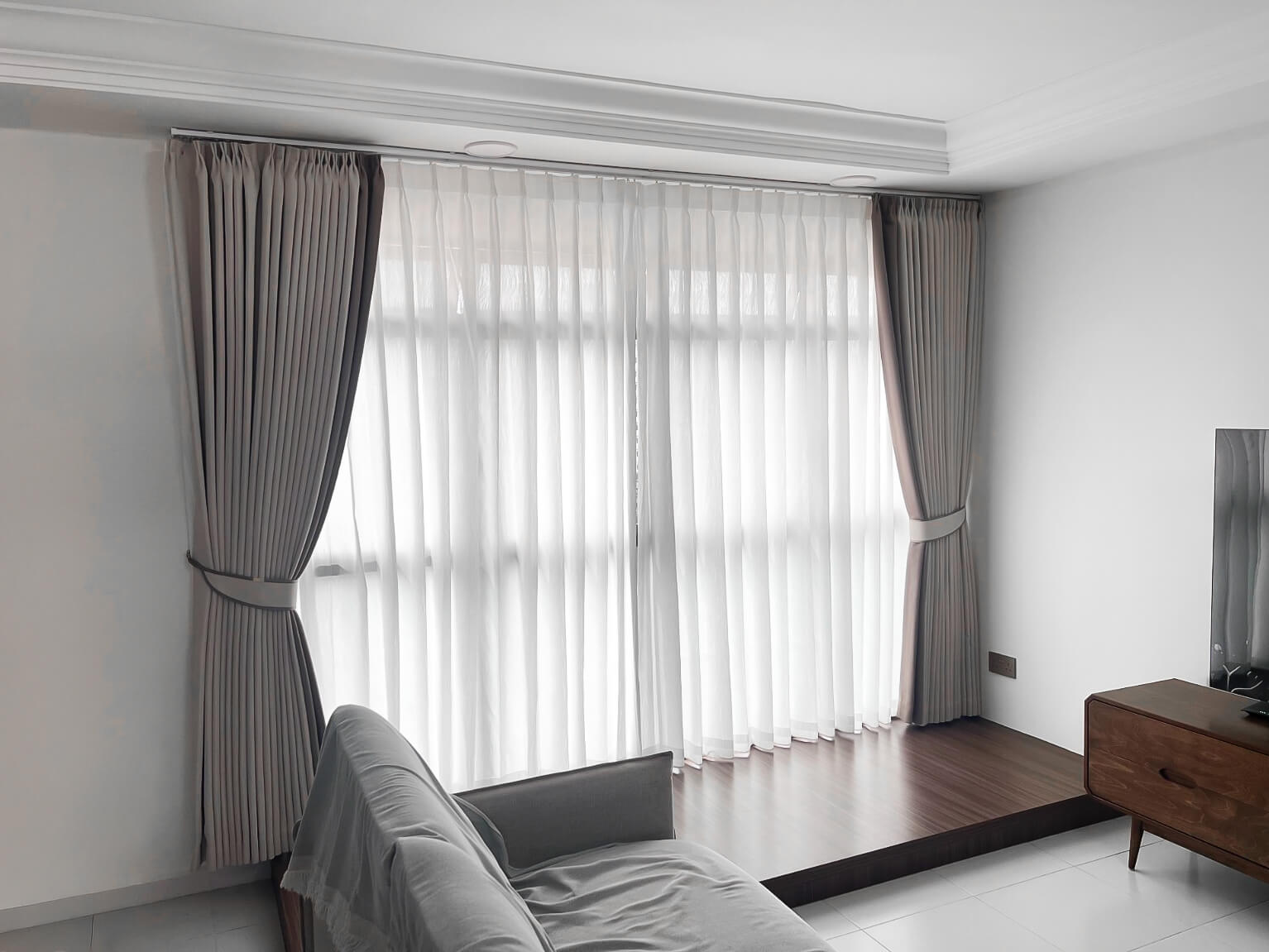
Many homeowners spend time comparing blackout fabrics but give less attention to the structure surrounding their curtains. That can lead to an unexpected result: the curtain material is opaque, yet the bedroom still appears bright because light enters above the track, along the sides, between the curtain panels or below the fabric.
In short: blackout curtains work best when the fabric, curtain track, pelmet, side coverage and centre overlap are planned as one system. If stronger room darkening is important, speak to our Design Consultants before your contractor or ID completes the false ceiling, carpentry and electrical work.
For homeowners who are sensitive to light, these installation details can matter just as much as the blackout fabric itself. This is especially relevant for bedrooms in Singapore condominiums, HDB flats and landed homes, where renovation decisions such as pelmet depth, window-side carpentry and air-conditioning box-ups are often finalised early.
If you are still deciding whether blackout curtains, blinds or a track-guided system would suit your room best, read our guide to comparing blackout solutions for Singapore bedrooms. It explains how different curtain and blind systems manage light gaps, privacy and room-darkening needs.
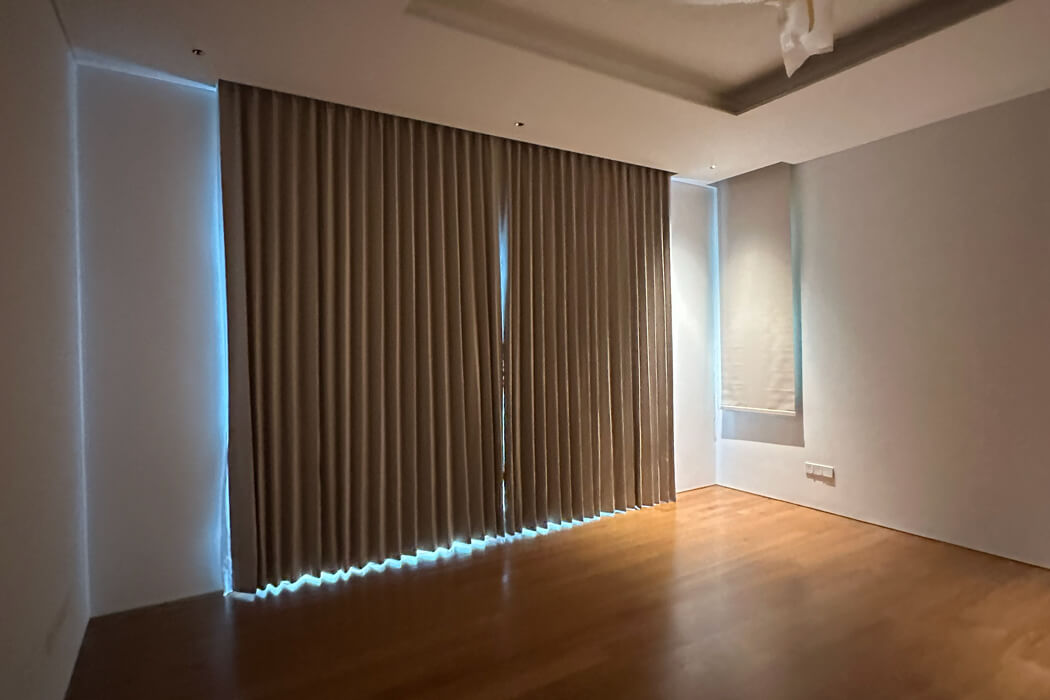
Why Do Blackout Curtains Still Let Light In?
A blackout curtain can prevent light from passing through its fabric while still allowing light around its edges. The most common entry points are:
- The open space above the curtain track
- Gaps between the curtains and side walls
- The meeting point between two curtain panels
- Space below curtains that end above the floor
- Insufficient curtain width beyond the window opening
- Obstructions such as furniture, window handles or air-conditioning structures
When the rest of a room is dark, even a narrow line of daylight can feel very noticeable. This is why the expected result should be discussed in terms of the complete curtain installation, not only the blackout percentage of the fabric.
Where Do Light Gaps Around Blackout Curtains Come From?
| Area | Why Light Enters | Possible Solution |
|---|---|---|
| Above the curtains | Light passes over the track | Build a suitable curtain pelmet |
| At both sides | Curtain edges sit away from the wall | Provide wider coverage or side Velcro |
| At the centre | Two panels meet without overlapping | Use an overlap arm track and secure the panels with Velcro, magnets or pins. |
| Below the curtains | Curtains end above the floor | Plan the finished curtain length carefully |
What Is a Curtain Pelmet?
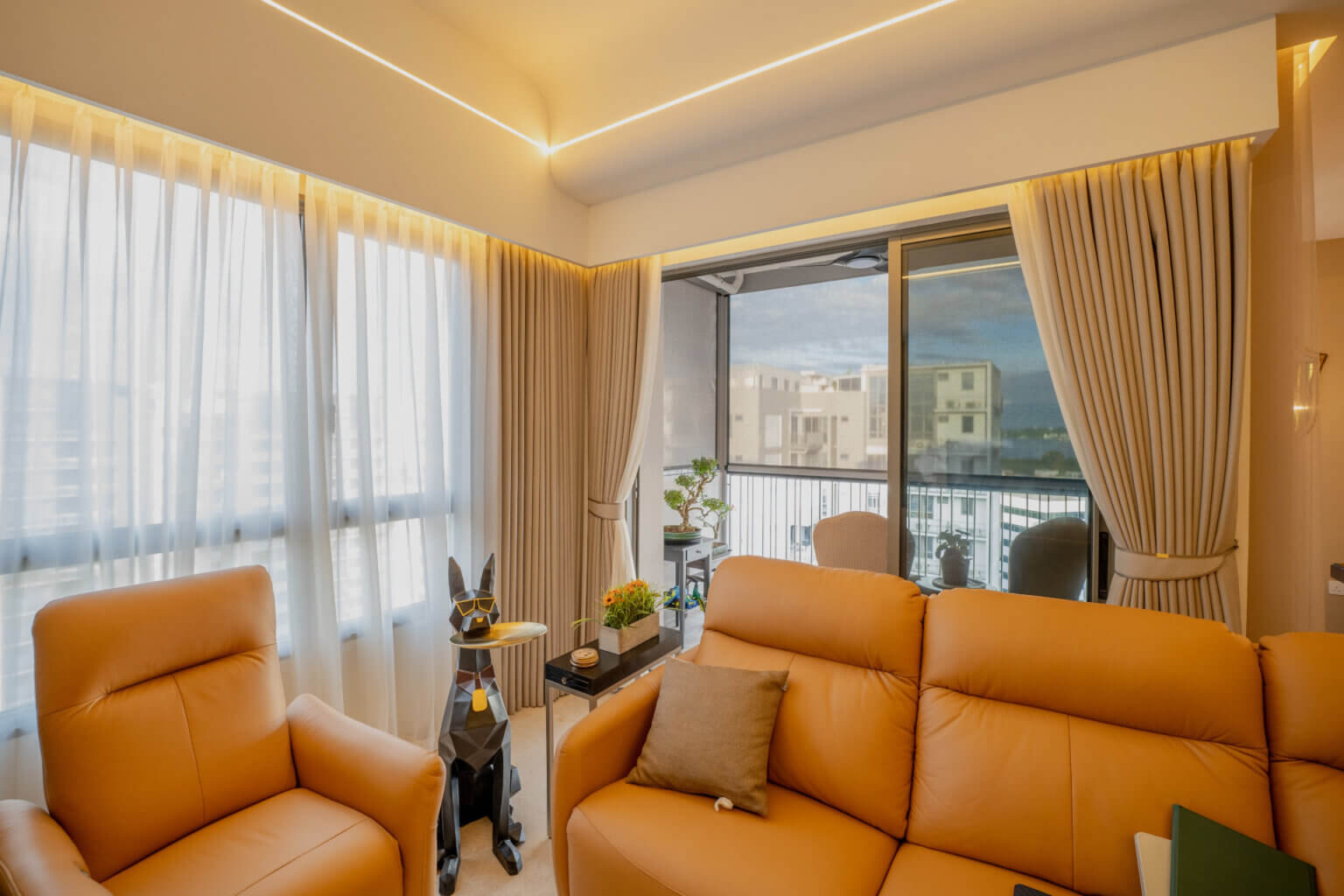
A curtain pelmet is a structure above the curtain track that conceals the curtain hardware. It may be formed as part of a false ceiling, built with carpentry or designed as a separate decorative feature. Beyond creating a neater finish, it can help reduce light spilling over the top of the curtains.
Without a pelmet, light can travel through the open space between the track and ceiling. This is especially noticeable when the room is used in the daytime, when the window receives direct morning or afternoon sun, or when a bedroom needs stronger room darkening.
A pelmet does not make every curtain installation completely dark, but it addresses one of the most common and overlooked sources of light leakage.
Why Should You Not Confirm Pelmet Size Too Early?
There is no single pelmet dimension that works for every curtain installation. The required space depends on:
- The curtain heading style
- The number of fabric layers / whether day and night curtains are required
- The selected curtain track
- Fabric fullness and thickness
- Manual or motorised operation
- Motor and component dimensions
- How much fabric must stack at the side
- Access required for installation and future servicing
A pelmet that is too narrow may compress the curtain folds or cause the fabric to rub against the wall. A pelmet that is too shallow may not fully conceal the track or reduce the light entering above it. It may also be difficult to access the track, motor or cover for future adjustments and servicing.
Once the curtain style and track are confirmed, the contractor can build the ceiling recess or carpentry to the required clearance. A standard recess may not accommodate double tracks, fuller curtains or a motorised system.
Do Single and Double Curtain Tracks Need Different Space?
Yes, a single curtain track may be suitable when you only want one layer, such as night curtains or blackout curtains. A double-track setup is usually needed when you want both day and night curtains. The sheer or day curtain and the blackout curtain need enough separation to move smoothly without catching on one another.
A double-track pelmet needs to accommodate:
- Both tracks
- Curtain folds on each layer
- The distance between the fabrics
- Track brackets or ceiling supports
- Any motorised components
- Access for adjustments and servicing
Trying to fit two curtain layers into a recess designed for one may cause the curtains to sit unevenly, restrict movement or make the pelmet feel overly tight.
How Do Side Gaps Affect Room Darkening?
Curtains naturally sit away from the wall because the track, curtain hooks and fabric folds create depth. This can leave a visible gap on either side of the window. A wider curtain track can help the fabric extend beyond the window opening, although the available coverage depends on nearby walls, switches, wardrobes and other site conditions.
For homeowners who need stronger room darkening, side velcro may also be considered. One side of the Velcro is positioned near the wall, while the corresponding piece is attached to the curtain edge. When the curtains are closed, the curtain edges can be secured closer to the wall to reduce the open side gaps.
Side velcro can be particularly useful for:
- Bedrooms exposed to strong morning sun
- Rooms facing corridor lighting
- Nurseries used for daytime naps
- Shift workers sleeping during the day
- Media rooms where stray light affects the screen
Side velcro requires a small manual step when opening and closing the curtains. It is therefore most suitable when stronger room darkening matters more than quick daily operation.
Why Does Light Enter Between Two Curtain Panels?
Most curtains are made as two panels that draw from the centre towards opposite sides. When conventional curtain tracks close, the panels may only meet at the centre. Small changes in fabric position can then create a narrow vertical gap, which is especially visible when the room is dark and the window is bright.
An alternative is a single-panel curtain on a one-way-draw track. Because there is no centre join, this arrangement removes the light gap that can appear where two curtain panels meet. The curtain opens and stacks to one side instead, so it is most suitable when there is enough clear wall space beside the window to accommodate the fabric when open.
For two-panel, centre-draw curtains, a curtain track with an overlap arm can help reduce the centre light gap. Curtain systems with overlapping panels are specifically designed to minimise light leakage at the centre where the fabrics close.
An overlap arm extends the leading carrier of one curtain panel so that it passes slightly in front of the other panel when the curtains close. Instead of meeting edge to edge, the two curtain panels overlap. This helps reduce light entering through the centre and can also provide better privacy.
One-way-draw curtains remove the centre join; centre-draw curtains preserve a more balanced opening but usually benefit from an overlap arm for stronger room darkening.
Should Blackout Curtains Touch the Floor?
For stronger room darkening, blackout curtains are usually planned to reach the finished floor level. Curtains that stop noticeably above the floor can leave a visible gap underneath, allowing light to enter the room.
For most Singapore homes, a clean floor-length finish is the most practical option. The curtain can lightly touch the floor or have a slight break, where a small amount of additional fabric rests at the base. This can help reduce the bottom light gap while keeping the curtains neat and manageable for daily use.
Some homeowners may prefer a more deliberate puddled look, where additional fabric gathers on the floor. This softer, more decorative style can further reduce light from below, but requires more maintenance as extra fabric can collect dust, interfere with robot vacuums and make cleaning around the window more difficult.
The final length should be confirmed after the finished floor level and carpentry is completed.
When Should You Speak to a Curtain Specialist?
The best time is before your contractor completes:
- False ceilings
- Curtain pelmets
- Built-in wardrobes near windows
- Electrical points for motorisation
- Air-conditioning box-ups
- Window grilles
- Carpentry beside the curtain stack
An early discussion does not mean you need to manufacture the curtains immediately. It simply allows the contractor to reserve the required space and avoid building structures that interfere with the future installation. The final curtain measurement will be completed later once the site is ready.
Can Light Gaps Be Fixed After Renovation?
Some improvements can be added after renovation. For example, side velcro may be installed to hold curtain edges closer to the wall. A different track or magnets/pins may improve centre overlap, and curtains may sometimes be adjusted or remade with more width.
However, adding a properly sized ceiling pelmet after renovation may involve carpentry, painting and other rectification work. It can also affect built-in furniture, lighting or air-conditioning structures close to the window.
Early planning is usually more practical than attempting to correct every light gap after the curtains have already been installed.
If the current curtain system no longer suits your room-darkening needs, you may also find it helpful to compare other blackout solutions for Singapore bedrooms, including blackout blinds and track-guided systems that manage gaps differently.
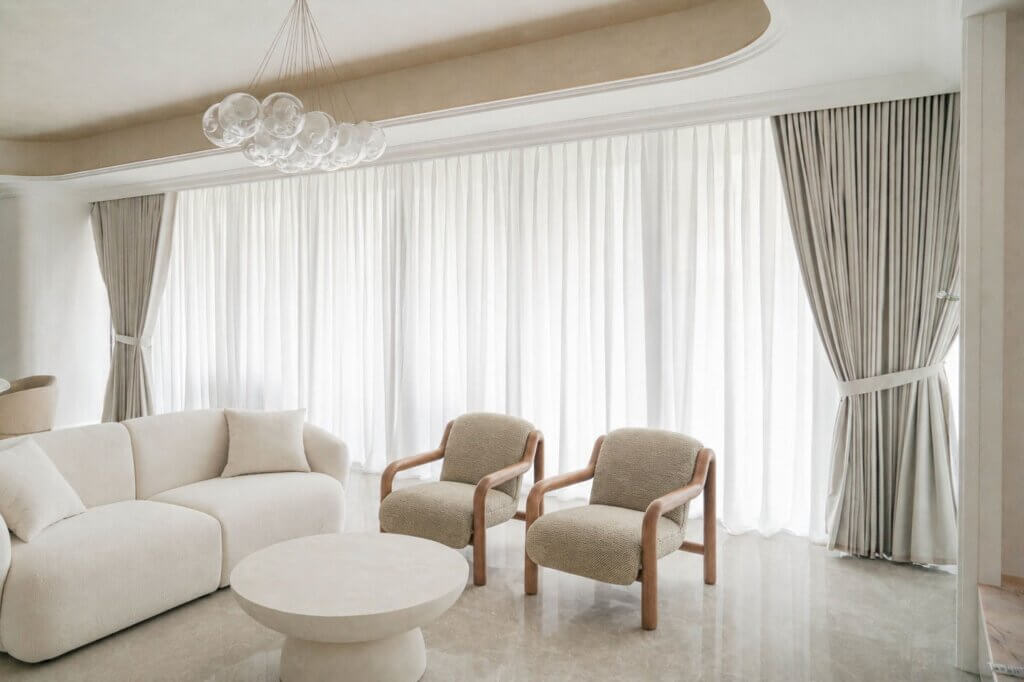
Plan the System, Not Just the Fabric
The most effective blackout curtain setup coordinates several details:
- Opaque or blackout fabric
- Suitable curtain width and fullness
- A properly sized pelmet
- Adequate side coverage
- A centre overlap where suitable
- A floor-length finish that suits the desired room-darkening level, cleaning routine and visual style
- A track designed for the curtain weight
- Space for motorisation and servicing where required
Not every homeowner needs every feature. The right setup depends on the room’s light exposure, window layout, renovation plan and how sensitive the occupants are to light.
At The Curtain Boutique, our Design Consultants can help advise you on the most suitable curtain style, fabric, track and pelmet requirements before surrounding renovation work is completed.
Visit our showroom to compare blackout curtains and curtain-track options in person, or book a personalised consultation based on your room layout and renovation plans.
The Curtain Boutique Showroom Gallery:
📍 33 Ubi Ave 3, Vertex, #01-01, Singapore 408868
📞 +65 6904 8813