

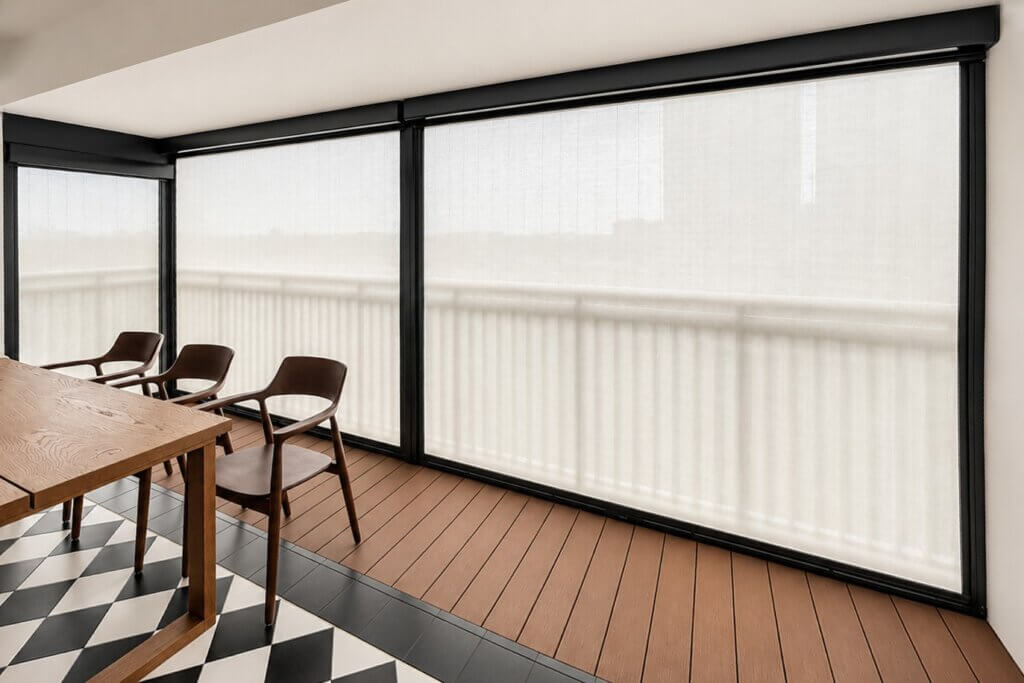
Choosing between 1% and 5% outdoor blind fabric might seem like a minor decision, but the difference can become quite noticeable once the blinds are installed. A balcony that receives direct afternoon rain may benefit from a tighter weave, while another that is naturally sheltered by neighbouring buildings could be more comfortable with greater ventilation. Even within the same condominium, homeowners can have different preferences depending on how they use their outdoor spaces.
For those comparing outdoor blinds, balcony blinds, zip blinds or zip track blinds in Singapore, 1% openness fabric generally offers better protection against wind-driven rain, greater daytime privacy and reduced air exchange, while 5% openness fabric provides better ventilation and clearer outdoor views. Neither is necessarily the better option for every home.
At The Curtain Boutique, we offer both options with our genuine Ziptrak® outdoor blinds. Rather than choosing based on the percentage alone, it is worth considering your balcony’s surroundings, how often you use the space and what you want the blinds to achieve.
Understanding the Difference Between 1% and 5% Openness
Before deciding which fabric to use, it helps to understand what these percentages actually mean. The openness factor describes the proportion of small openings within a woven fabric. A 1% openness fabric has a tighter weave with fewer openings, while a 5% openness fabric has a more open construction that allows greater amounts of light and air to pass through.
This does not mean that 1% fabric blocks exactly 99% of sunlight, heat or rain. Those characteristics are also influenced by the fabric’s material, colour and construction. The percentages are better understood as an indication of how open or tightly woven the material is, rather than an exact measurement of overall weather protection.
For homeowners, the difference becomes easier to understand when considering how each fabric performs in everyday situations.
When Your Balcony Is Exposed to Afternoon Sun and Rain
Singapore’s weather can change quickly, with bright sunshine giving way to sudden showers. If your balcony faces an open area with little shelter from surrounding buildings, the amount of rain entering the space may be one of your main concerns.
In such situations, 1% openness fabric is generally the more practical option. Its tighter weave helps reduce harsh sunlight and glare while offering better resistance to wind-driven rain than 5% fabric. Although some water may still pass through during heavy showers, particularly when strong winds blow directly against the blinds, the smaller openings can make a noticeable difference to the amount of rain reaching the balcony.
This is especially relevant if you have outdoor furniture, plants or other belongings that you would prefer to keep sheltered. However, homeowners should not expect either fabric to provide a completely waterproof enclosure. Even with a track-guided system such as Ziptrak®, water may enter around parts of the installation under certain conditions.
For balconies that are particularly exposed, it is worth assessing the direction of incoming rain rather than choosing fabric based solely on the floor level. A higher-floor balcony is not automatically more exposed than a lower-floor one, just as two units facing different directions may experience very different weather conditions.
When Your Balcony Doubles as Part of the Living Room
For some homeowners, the balcony is not simply an outdoor space used occasionally. With the right furnishings and shading, it can become an extension of the living room, providing additional space for dining, relaxing or entertaining guests.
This is where 1% openness fabric has another practical advantage. In Singapore’s hot and humid climate, homeowners who leave their sliding glass doors open while running the air-conditioning may benefit from the tighter weave, which helps reduce the exchange of cooled indoor air with warmer outdoor air.
Compared with 5% fabric, 1% openness can help retain more cooled air when the outdoor blinds are lowered. It will not keep all the cool air inside, however, as air can still escape through the fabric and surrounding installation gaps. The actual effect also depends on the air-conditioning system, balcony layout and outdoor weather conditions.
Nevertheless, if you frequently use your balcony and living room as one connected space, the additional screening provided by 1% fabric may be more valuable to you than the extra airflow offered by 5%.
When Your Balcony Is Naturally Sheltered
Not every condominium balcony needs the same level of protection against rain and wind. Some units are recessed within the building, while others are partially sheltered by neighbouring blocks, adjoining units or architectural features that reduce direct exposure to the elements.
Through our experience working with homeowners, we have encountered situations where customers are less concerned about strong winds blowing rain into their balconies because the surrounding structures already provide a degree of shelter. For these households, choosing the tightest fabric may not necessarily be the priority.
A 5% openness fabric can be particularly suitable in these circumstances. Its more open weave allows greater natural ventilation even when the blinds are lowered, helping the balcony retain an airy, outdoor atmosphere. This can be especially enjoyable for homeowners who prefer spending time outside without air-conditioning but still want some protection from direct sunlight.
Of course, natural shelter does not mean the balcony will never experience wind-driven rain. Weather conditions can change, and 5% fabric generally allows more droplets through than 1%. The decision therefore comes down to whether the homeowner is comfortable accepting some reduction in rain protection in exchange for better airflow.
When You Want to Enjoy the View Without Raising Your Blinds
A balcony overlooking greenery, a swimming pool or the city skyline is often one of the home’s most appealing features. For homeowners who value these views, choosing outdoor blinds that make the space feel too enclosed can defeat part of the reason they enjoy their balcony in the first place.
Generally, 5% openness fabric offers clearer outward visibility because of the larger openings in its weave. More natural light also passes through, giving the balcony a brighter appearance. This makes it appealing for homeowners who want to keep their blinds lowered during the day without losing too much of their connection to the outdoors.
However, the openness percentage is not the only factor that affects visibility. Fabric colour can also make a noticeable difference. Lighter shades, such as white and light grey, tend to reflect and diffuse more visible light, while darker shades can sometimes provide clearer outward visibility because they produce less reflected glare on the fabric surface.
In other words, a dark-coloured 1% fabric may offer a clearer view than you might expect, even with its tighter weave. This is why we recommend viewing physical fabric samples against an outdoor background rather than choosing based on photographs or colour swatches alone.
When Privacy Matters, Especially After Dark
For balconies facing neighbouring residential blocks, privacy may be just as important as weather protection. While 1% openness generally offers greater screening than 5%, the level of privacy you experience can change considerably between daytime and night-time.
During the day, the brighter outdoor environment can make it harder for people outside to see into a darker living space. Once the sun sets and your interior lights are switched on, that balance changes. People outside may be able to see silhouettes or activity through the fabric more easily, even when the blinds are fully lowered.
Homeowners who require greater daytime privacy may therefore prefer 1% openness, but neither 1% nor 5% woven fabric should be treated as a complete night-time privacy solution. The distance between neighbouring buildings, surrounding lighting and fabric colour can all influence visibility.
If privacy after dark is a major concern, it is worth discussing your requirements with a Design Consultant before selecting the fabric. Other materials may offer stronger screening, although their suitability will depend on your condominium’s permitted options and your preference for natural light and ventilation.
Comparing 1% and 5% Outdoor Blinds for Different Needs
The most suitable fabric often becomes clearer when you consider what matters most in your daily routine.
| Your Priority | 1% Openness | 5% Openness |
|---|---|---|
| Protection against wind-driven rain | Better choice | Less protection |
| Using the balcony with air-conditioning | Helps reduce air exchange | Allows greater air exchange |
| Natural ventilation | More restricted | Better choice |
| Enjoying outdoor views | More filtered | Generally clearer |
| Daytime privacy | Greater screening | Less screening |
| Naturally sheltered balcony | Suitable | Often worth considering |
These are general comparisons rather than guarantees of performance. The fabric’s construction, colour, installation and surrounding environment can all influence the final result.
For homeowners who need greater rain protection or different material characteristics, there are also specialised options beyond conventional 1% and 5% woven fabrics. Our guide to five Ziptrak® outdoor blind fabrics explains these alternatives in greater detail.
Choosing Between 1% and 5% for Your Condominium
One consideration that can narrow down your choices before you even begin comparing fabrics is your condominium’s approval requirements. Many developments have their own guidelines governing the colour, appearance and material of outdoor blinds to maintain a consistent building façade.
Some condominiums permit homeowners to choose between 1% and 5% openness fabrics, while others may specify particular materials or allow additional options. The requirements vary between developments, making it important to check with your Management Corporation Strata Title (MCST) or managing agent before confirming your order.
One advantage of Ziptrak® is that it is a retractable outdoor blind system rather than a permanent balcony enclosure. Unlike fixed walls or glass panels, the blinds can be raised completely when not required, allowing homeowners to enjoy greater protection against sunlight and rain while retaining the balcony’s semi-outdoor character.
According to the Urban Redevelopment Authority’s guidelines for strata-titled residential properties, balconies are intended to remain semi-outdoor spaces, and blinds are regarded as furnishings that may be installed without URA planning permission. However, this does not override condominium management rules, and homeowners must still obtain any necessary MCST approval.
If you are unfamiliar with the approval process, our guide to Singapore condominium balcony blind requirements explains what homeowners should check before proceeding with an installation.
Why Your Balcony’s Surroundings Matter More Than the Percentage Alone
It can be tempting to choose 1% fabric simply because it offers greater protection or 5% because it provides better ventilation. However, neither approach takes into account the conditions that make each balcony different.
Before deciding, consider where the afternoon sun enters, how rain behaves during windy weather and whether neighbouring buildings provide shelter. It is also useful to think about how you use the balcony throughout the day. Someone who spends most evenings there without air-conditioning may value ventilation more than a homeowner who keeps the sliding doors open to extend an air-conditioned living room.
Seeing the two fabrics in person can also help. Where possible, compare samples of similar colours under the same lighting conditions, and view them against the outdoor surroundings. This provides a more realistic impression of the differences than relying on openness percentages alone.
Making the Right Choice for Your Home
Both 1% and 5% outdoor blind fabrics have their place in Singapore homes. For a balcony that receives direct sun and wind-driven rain, or one frequently used together with an air-conditioned living room, 1% openness may be the more practical option. For a naturally sheltered balcony where outdoor views and ventilation are the priorities, 5% openness can offer a more comfortable balance.
Ultimately, the aim is not to choose the fabric that provides the greatest protection in every category, but to find one that complements your surroundings and the way you use your home.
At The Curtain Boutique, we have been installing genuine Ziptrak® outdoor blinds in Singapore since 2017. Our Design Consultants can help you evaluate your balcony’s exposure, surrounding structures, approved fabric options and daily usage before recommending a suitable solution.
Visit our showroom to compare the fabrics in person, or arrange a consultation to find out whether 1% or 5% openness is better suited to your balcony.
Visit The Curtain Boutique Showroom Gallery at:
📍 33 Ubi Ave 3, Vertex, #01-01, Singapore 408868
📞 +65 6904 8813